
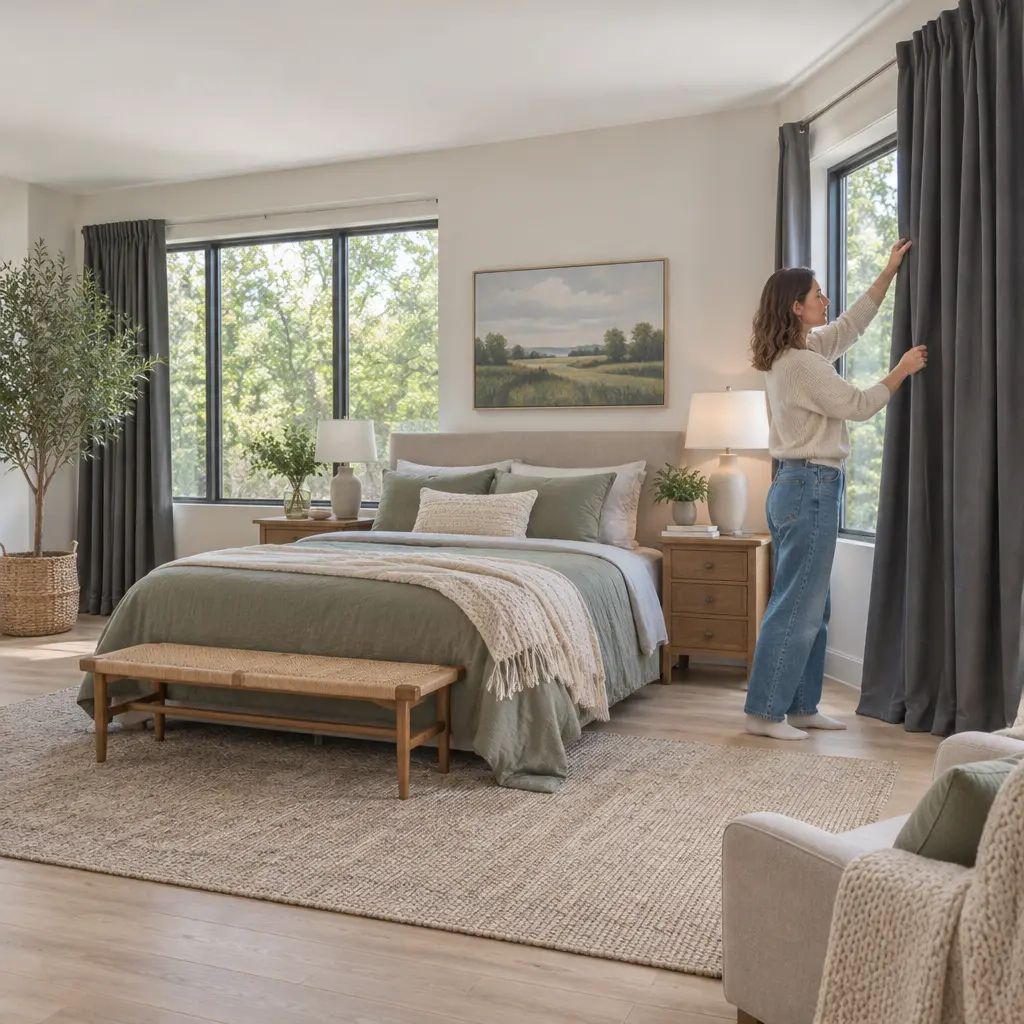
A bedroom sanctuary is a sleep-focused room designed first to reduce disruptive light and sound, then to support comfort and personal style. That order matters: the Centers for Disease Control and Prevention recommends a quiet, relaxing, cool bedroom, while the National Institute for Occupational Safety and Health notes that light and noise can disrupt sleep and circadian rhythms. A practical design therefore starts with control of daylight, nighttime illumination, and sound; adds appropriate materials and room arrangements; and only then layers in color, furnishings, and décor.
Bedroom sanctuary design prioritizes environmental control
“Bedroom sanctuary design” is a practical design approach rather than a standardized medical or architectural term: it means arranging a bedroom to support rest by managing environmental conditions—especially light and sound—before making aesthetic choices. The approach reflects established sleep guidance. The CDC recommends a quiet, relaxing environment and identifies light, noise, and temperature as factors relevant to healthy sleep. The American Academy of Sleep Medicine and Sleep Research Society recommend that adults regularly obtain at least seven hours of sleep per night, underscoring why conditions that interrupt sleep deserve attention.
The main design categories are light control, acoustic control, and the supporting choices that make those controls work: window treatments, lighting, room layout, furnishings, and building or household noise management. These measures cannot guarantee better sleep or replace medical care for persistent insomnia, but they can reduce common environmental disturbances. A useful sequence is to identify the disturbance, address its source, and then choose finishes that complement the solution.
Light management: block unwanted light and use illumination deliberately
Light management is the reduction of unwanted brightness during sleep and the intentional use of light at other times. The National Institute of General Medical Sciences explains that circadian rhythms are internal cycles influenced by environmental cues, particularly light and darkness. In bedroom design, this means treating daylight leakage, streetlights, illuminated devices, and bedside lamps as separate sources rather than relying on a single decorative solution.
Begin with a nighttime check: observe the room after dark, including light around the edges of curtains, beneath doors, and from displays or chargers. Well-fitted blackout curtains or shades can reduce incoming light; side channels or overlapping panels may help where light leaks around the edges. A removable eye mask is a low-cost alternative when window changes are impractical. For evening use, choose low-level, warm-toned lighting and place it where it does not shine directly into the eyes. Keep bright screens out of the sleep routine where possible, and use dim, safe lighting if nighttime movement is necessary.
Blackout treatments are not automatically the right choice for every person or schedule. People who need morning daylight to wake, work shifts, or share a room may prefer adjustable shades or layered treatments. The design objective is control: the room should be dark enough for the sleeper’s needs at bedtime while allowing daylight to enter when desired.
Sound control: reduce intrusion before adding masking sound
Sound control is the reduction of disruptive noise reaching the sleeping area. The World Health Organization’s environmental-noise guidance links excessive noise exposure with adverse health effects, including sleep disturbance. Its recommendations address population-level environmental exposure rather than setting a universal bedroom threshold; actual disturbance depends on sound level, timing, repetition, and individual sensitivity.
First identify the source: traffic, neighbors, plumbing, appliances, pets, or sounds within the household. Low-cost steps include moving the bed away from a shared wall or window, sealing obvious gaps around doors, adding a door sweep, and using dense curtains to soften reflections. Rugs, upholstered furniture, and bookshelves can reduce reverberation inside a room, but they are not substitutes for sound insulation: soft furnishings absorb some reflected sound, whereas blocking noise from another room or outdoors generally requires a more effective barrier and attention to gaps.
A fan or sound machine may help some sleepers by providing steady background sound, but it does not remove the underlying source. Keep playback at a comfortable, moderate level and avoid placing a speaker close to the head. If noise is persistent or unusually loud, investigate building maintenance, window seals, appliance faults, or local noise-control options rather than simply increasing masking volume.
Room layout and materials: support light and sound solutions
Room layout and material selection are the supporting layer of sanctuary design. Positioning the bed away from a direct line to street-facing windows or a noisy shared wall may improve perceived comfort, although the result depends on the building and noise source. A rug, fabric headboard, and curtains can make a room feel less echoing; their primary contribution is acoustic absorption and softness, not complete soundproofing.
Consider practical constraints before purchase: window dimensions, curtain-rod strength, ventilation, fire-safety requirements, cleaning needs, and whether a treatment blocks an emergency exit or a required source of daylight. Renters can often begin with reversible options such as tension rods, removable draft seals where permitted, eye masks, and rearranged furniture. In shared homes, agree on quiet hours and device use, because household habits can matter as much as furnishings.
Bedroom sanctuary design turns environmental needs into aesthetic choices
Once disruptive light and sound have been addressed, aesthetics can reinforce the room’s purpose. Color, texture, and visual simplicity are personal preferences, not guaranteed treatments for sleep problems. The design principle is to choose attractive items that preserve the environmental controls: curtains that actually cover the window, lamps that can be dimmed, and furnishings that do not introduce avoidable noise or clutter.
Aesthetic choices that preserve function
A functional palette can use calming colors if the occupant finds them restful, but no single color scheme is medically established as necessary for sleep. Select bedside lighting with accessible controls, and avoid decorative fixtures that expose a bright bulb at eye level. Layered window treatments can combine a visually pleasing outer curtain with a practical shade. Soft textiles may improve comfort and reduce room echo, while washable materials help keep the space maintainable.
For a shared bedroom, prioritize adjustable controls: separate reading lights, individual eye masks, or independently operated shades can accommodate different schedules. A design that works for the people using it is more useful than a staged room that looks serene but cannot be darkened, quieted, or adapted.
A measured, low-cost design sequence
A simple audit can prevent spending on décor before the actual problem is understood. Record when light or sound interrupts rest, where it comes from, and whether it is occasional or regular. A phone light-meter or sound-meter app can offer a rough comparison between locations or times, but consumer apps are not calibrated substitutes for professional measurement and should not be treated as medical assessments.
- Observe the room at bedtime and early morning; note light leaks, repeated sounds, and the location of their sources.
- Try reversible fixes first, such as repositioning the bed, closing or covering light gaps, adjusting device settings, and changing household routines.
- Invest in targeted improvements—such as fitted shades, door seals, or repair of a noisy fixture—based on what the audit identifies.
- After the environment is working, select bedding, color, art, and accessories that suit personal taste without undoing the controls.
For example, a renter disturbed by a streetlight can test an eye mask and a well-fitted temporary blackout curtain before purchasing custom window treatments. Someone awakened by a rattling fan should repair or replace the source rather than rely on louder background audio. These examples illustrate the same principle: diagnose first, choose the least disruptive effective intervention, and evaluate whether it helps.
Conclusion: build the bedroom sanctuary from the inside out
Bedroom sanctuary design is most effective when it treats light management and sound control as foundational, then uses layout and materials to support them, and adds aesthetics last. Sleep guidance from the CDC, circadian-rhythm research summarized by the National Institute of General Medical Sciences, and environmental-noise guidance from the World Health Organization all reinforce the relevance of a bedroom’s surroundings—without implying that décor alone can solve sleep disorders.
Start with a short room audit, address the most noticeable source of disturbance, and make changes that fit your household and budget. If sleep remains persistently difficult despite improving the environment, consult a qualified healthcare professional; a bedroom redesign is not a substitute for assessment or treatment.
Sources: Centers for Disease Control and Prevention, About Sleep, https://www.cdc.gov/sleep/about/index.html; Watson, N. F., et al., Recommended Amount of Sleep for a Healthy Adult: A Joint Consensus Recommendation of the American Academy of Sleep Medicine and Sleep Research Society, https://jcsm.aasm.org/doi/10.5664/jcsm.4758; National Institute of General Medical Sciences, Circadian Rhythms, https://nigms.nih.gov/education/fact-sheets/Pages/circadian-rhythms.aspx; World Health Organization Regional Office for Europe, Environmental Noise Guidelines for the European Region, https://www.who.int/europe/publications/i/item/9789289053563