
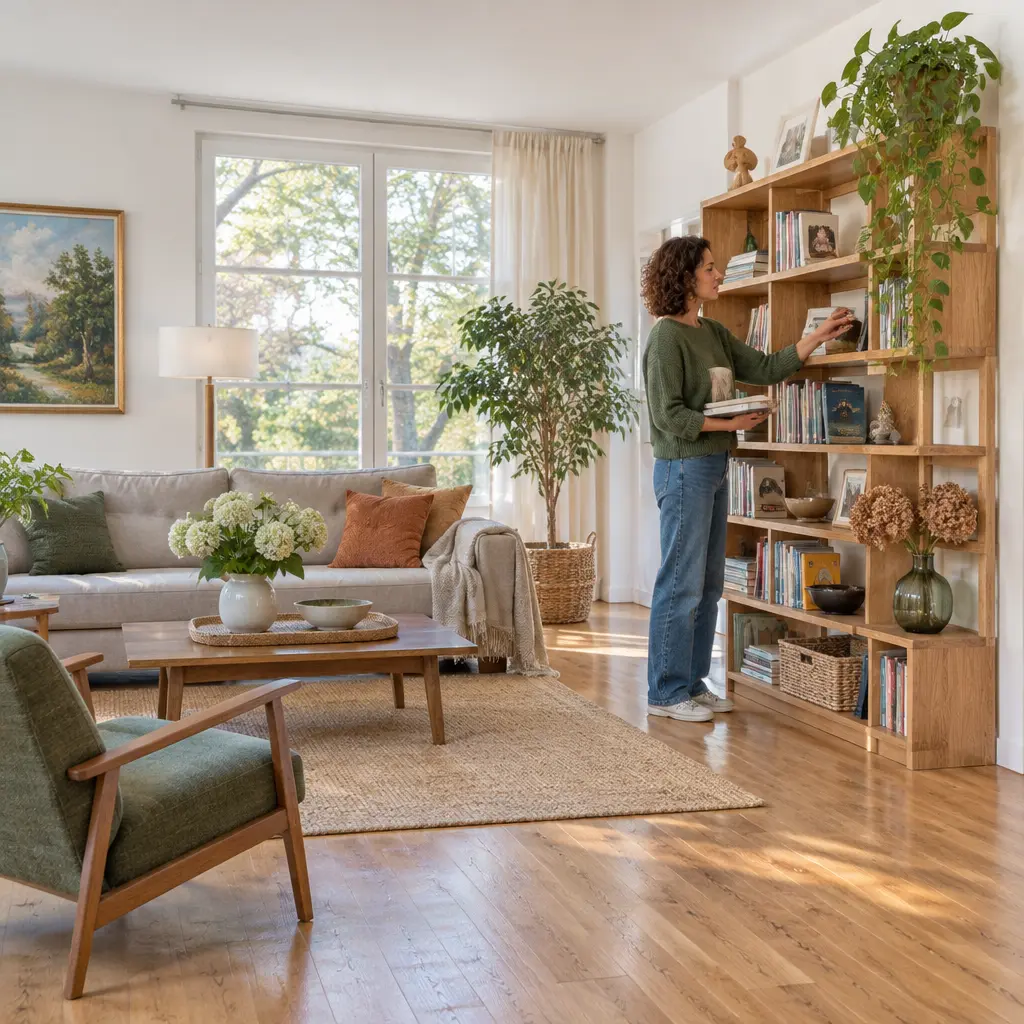
An authentic home vibe is the feeling that a space reflects the people who live in it rather than a furniture showroom or a trend checklist. Building that feeling through intentional editing means choosing objects, colors, and furnishings for their usefulness, personal meaning, or visual contribution—and giving them room to matter—instead of layering more and more decor. This approach connects interior design with well-being: the World Health Organization’s review of evidence on urban green spaces, for example, found that access to nature can support health and well-being, while home-environment research has linked perceived clutter with stress. The practical lesson is not to strip a home bare, but to edit with care: keep meaningful pieces, improve function, preserve signs of daily life, and make changes gradually.
Intentional Editing Defines an Authentic Home Vibe
“Intentional editing” is a useful design principle, not a formal technical term with one universally accepted definition. In this article, it means evaluating each item and design decision by how well it serves the residents, supports everyday routines, or contributes to a coherent visual experience. Interior designer William Morris expressed a related principle in the often-quoted advice to keep nothing in the home that is not useful or believed to be beautiful. The idea does not require choosing between practicality and sentiment: an object can be useful, beautiful, personally significant, or some combination of the three.
That distinction matters because an authentic home is not defined by a specific style. A room can be traditional, contemporary, eclectic, or minimal and still feel personal. Its authenticity comes from the connection between the space and its occupants. Intentional editing helps make that connection visible by prioritizing a few meaningful layers over indiscriminate accumulation.
Meaningful objects and visual breathing room
Meaningful objects are belongings that carry a story, support a routine, or express a resident’s taste. They may include family photographs, a well-used chair, a travel souvenir, or a collection built over time. Visual breathing room is the unoccupied surface or wall area that allows selected pieces to register clearly. Editing does not mean removing every keepsake; it means deciding which items deserve attention now and where they will be most appreciated.
A practical test is to group similar objects, select the pieces with the strongest personal or functional value, and display them together rather than distributing them across every available surface. This creates a focal point and makes later changes easier. The National Institute of Mental Health notes that stress can affect daily life and that people respond to stress in different ways; that does not prove that decluttering treats stress, but it supports a measured approach to home changes rather than treating one aesthetic as a universal prescription.
Function, comfort, and the lived-in signal
Function-led editing begins with how a household actually uses each room. A clear path through an entryway, reachable storage, comfortable seating, and lighting suited to a task can improve daily use more than another decorative layer. The U.S. Environmental Protection Agency explains that indoor air quality is influenced by sources of pollution, ventilation, and occupant activities. In practical terms, keeping pathways clear and avoiding unnecessary accumulation can make routine cleaning and ventilation easier, though editing alone cannot guarantee healthier indoor air.
A lived-in home also contains evidence of ordinary life: a blanket near the sofa, books in use, or a bowl where keys are routinely placed. These details feel authentic when they are supported by the room’s layout rather than scattered without purpose. The goal is not to conceal daily life, but to give it a workable home.
Intentional Editing Builds Cohesion Without Maximalist Layering
Cohesion is the sense that a room’s elements belong together, even when they are not part of a matching set. Intentional editing builds cohesion by identifying a few recurring cues—such as wood tones, a limited color family, repeated shapes, or a shared connection to place—and using them selectively. Maximalism, by contrast, often uses abundance, pattern, and collection as deliberate design tools. Neither approach is inherently more authentic; the difference is whether the composition reflects the residents and remains usable.
The Environmental Protection Agency’s household waste resources emphasize reducing consumption and reusing products as ways to limit waste. Applied to interiors, buying less and making thoughtful use of existing belongings can reduce unnecessary purchases. This is not a claim that editing a room by itself produces a measurable environmental benefit for every household; the impact depends on what is kept, repaired, reused, donated, or discarded.
Color and material restraint
Color and material restraint means choosing a manageable set of tones and finishes that can connect different furnishings without making everything identical. A room might combine warm wood, a neutral wall, and one or two colors drawn from artwork or textiles. This approach is especially useful when existing pieces were acquired at different times. Instead of replacing them to create a matching suite, residents can repeat a small number of visual cues to make the mix feel considered.
The connection to personal history is important: a favorite color, handmade textile, or locally sourced material can make a restrained palette feel individual rather than generic. A useful edit is to remove or relocate items that compete for attention, then observe the room at different times of day before purchasing anything new.
Collections, keepsakes, and rotation
A collection is a group of related objects gathered intentionally, while keepsakes are objects retained for personal or historical meaning. Both can contribute strongly to an authentic home, but displaying every item at once may make it difficult to appreciate individual pieces. Rotating a collection—keeping some objects safely stored and changing the display occasionally—preserves its significance while reducing visual crowding.
This is an example of editing without disposal. It also respects practical constraints such as limited shelf space, fragile items, and the needs of children or pets. Before donating or discarding anything, consider whether it belongs to someone else, has cultural or family significance, or can be repaired or reused.
A room-by-room editing method
A gradual process makes the decisions more manageable and helps residents avoid replacing one form of excess with another. The following sequence can be applied to a living room, bedroom, entry, or workspace:
- Identify the room’s main activities and the objects needed to support them.
- Remove items that are broken, duplicated, misplaced, or no longer useful, while setting aside anything that requires a family decision.
- Choose the personal objects and visual features that best express the room’s character.
- Arrange furniture and belongings to preserve comfortable movement, practical storage, and clear focal points.
- Live with the arrangement for several days before buying replacements or additional decor.
The method is intentionally flexible. Renters, people sharing a home, and households with limited space may have fewer choices about architecture or storage, so editing can focus on movable items, surfaces, and routines. A home’s authenticity should not depend on property ownership, expensive furnishings, or a particular amount of square footage.
Authentic Home Design Connects Personal Taste With Well-Being
A home’s atmosphere can influence how people use and experience it, but design claims should be kept proportionate to the evidence. The World Health Organization’s 2016 report, Urban Green Spaces and Health, reviewed evidence associating urban green space with health and well-being, including possible benefits related to psychological relaxation and social connection. That research concerns access to green space, not a direct trial of interior decorating. It nevertheless offers a useful design implication: natural light, plants where appropriate, and views or materials that connect a room to nature can be considered alongside comfort and personal preference.
Personalization is not the same as clutter
Personalization is the deliberate presence of objects and choices that reflect a resident’s identity. Clutter is often used to describe belongings that interfere with intended use, access, or a person’s comfort, although the boundary is subjective and context-dependent. A crowded bookcase may feel meaningful to one person and overwhelming to another. The relevant question is not whether a room looks sparse in a photograph, but whether its occupants can use it comfortably and feel represented in it.
Research by Saxbe and Repetti, published in the Personality and Social Psychology Bulletin in 2010, examined how couples described their home environments and reported associations between home descriptions, mood, and daily patterns of cortisol. The study does not show that every full room is harmful or that decluttering will improve health. It does underline that people’s experience of home environments is worth taking seriously—and that design advice should account for residents’ own perceptions.
A practical example: editing a living room
Consider a living room filled with mismatched cushions, souvenirs, small decorative objects, and furniture that blocks the route to a window. A maximalist solution might add more layers to make the arrangement feel deliberate. An editing-led solution starts instead with the room’s use: keep the seating that is comfortable, move the blocking furniture, select a few souvenirs with the strongest personal meaning, and group them where they can be seen. A cushion or throw can introduce color and texture, while unused objects can be stored, passed on, repaired, or donated according to the household’s needs.
The result need not be minimal. It may still contain books, art, plants, and family pieces. The difference is that each layer has a reason to be there, and the room retains enough space for movement and use. This example is a practical application of design principles, not a measured case study or a guarantee of a particular psychological outcome.
Conclusion: Edit for Meaning, Use, and Room to Live
An authentic home vibe comes from the relationship between a space and the people who live in it. Intentional editing supports that relationship by making meaningful objects easier to notice, prioritizing function and comfort, and creating cohesion without requiring maximalist layering or strict minimalism. Evidence on home perception, indoor environments, and access to nature offers useful context, but it does not establish a single ideal interior for everyone.
Start with one room or one surface. Decide what the space needs to do, keep what contributes to use or meaning, and pause before buying more. For further reading, consult the World Health Organization’s work on green spaces and health, the U.S. Environmental Protection Agency’s indoor air quality and waste-reduction resources, and research on how people experience their home environments. The most convincing home is not the one with the most layers; it is the one that makes room for the life happening inside it.
Sources: William Morris, “The Beauty of Life,” 1880, https://www.marxists.org/archive/morris/works/1880/hopes/chapters/chapter1.htm; World Health Organization Regional Office for Europe, Urban Green Spaces and Health: A Review of Evidence, 2016, https://iris.who.int/handle/10665/345751; U.S. Environmental Protection Agency, Introduction to Indoor Air Quality, https://www.epa.gov/indoor-air-quality-iaq/introduction-indoor-air-quality; U.S. Environmental Protection Agency, Reducing and Reusing Basics, https://www.epa.gov/recycle/reducing-and-reusing-basics; National Institute of Mental Health, 5 Things You Should Know About Stress, https://www.nimh.nih.gov/health/publications/stress; Darby E. Saxbe and Rena Repetti, “No Place Like Home: Home Tours Correlate With Daily Patterns of Mood and Cortisol,” Personality and Social Psychology Bulletin, 2010, https://doi.org/10.1177/0146167209352864.