
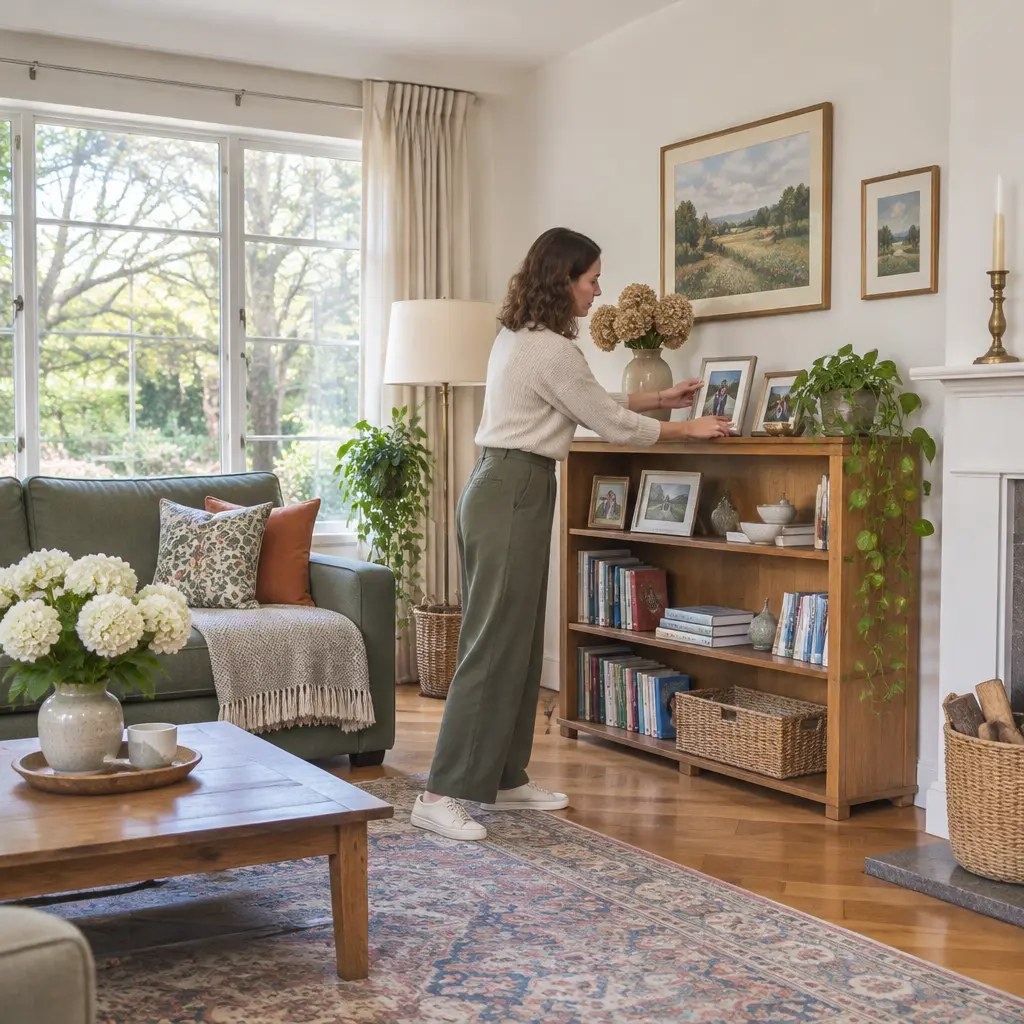
Personal vibe expression through objects is the practice of choosing and arranging meaningful belongings so a space reflects the people, memories, interests, and values behind it. Rather than following a single decorating formula, it combines personal artifacts, inherited pieces, collections, and everyday objects into a visual account of life. This matters in a world where belongings are plentiful but personal meaning is harder to manufacture: the U.S. Environmental Protection Agency reported that Americans generated 292.4 million tons of municipal solid waste in 2018, underscoring the value of making thoughtful choices about what we keep and display. A distinctive home can begin with memory objects, grow through collections and cultural artifacts, and become more coherent through deliberate arrangement, care, and ethical sourcing.
Personal Vibe Expression Defines Objects That Tell Your Life Story
“Personal vibe expression” is a useful description, rather than a formal academic term, for using objects to communicate an individual’s identity and experience. The underlying idea aligns with environmental psychology: people shape their surroundings, and those surroundings can in turn influence how they feel and behave. In The Meaning of Things: Domestic Symbols and the Self, psychologists Mihaly Csikszentmihalyi and Eugene Rochberg-Halton studied how people attach meaning to household objects and how possessions can help express identity and relationships.
The practice includes several related forms: autobiographical objects that recall events, heirlooms that connect generations, collections that reveal sustained interests, and functional items that embody a person’s taste or values. The strongest displays do not simply show what someone owns; they give viewers clues about what that person notices, remembers, and cares about. Because an object’s meaning depends on its owner and context, the same souvenir may be a travel memento for one person and an ordinary decoration for another.
Meaningful Objects Connect Memory and Identity
A meaningful object is a possession associated with a memory, relationship, achievement, place, or personal turning point. A concert ticket, a grandparent’s recipe box, or a well-used sketchbook can act as a cue that brings an experience to mind. Research on autobiographical memory, including work by psychologist Elaine Reese and colleagues on personal storytelling, emphasizes that people make sense of experience by organizing memories into narratives. Objects can support that process by giving an otherwise abstract memory a visible, tangible anchor.
A useful test is to ask what story an object brings to mind and whether it still matters to you. The answer need not be dramatic: a chipped mug may recall a first apartment, while a map may record a family road trip. Displaying a small number of such objects can make a space feel personal without turning every surface into storage.
Heirlooms and Cultural Artifacts Carry Shared Stories
An heirloom is an object passed between generations or retained as a marker of family history. Cultural artifacts—such as textiles, musical instruments, religious objects, or craft traditions—can also express a wider community’s identity. Their significance may be individual, collective, or both, so context matters: explaining who made or used an object, where it came from, and how it was passed along helps distinguish meaningful heritage from decoration alone.
The International Council of Museums’ definition of a museum emphasizes the preservation and interpretation of tangible and intangible heritage. The same principle can guide personal displays: care for the object, record what is known about its history, and avoid claiming a provenance that cannot be verified. For culturally sensitive items, consider whether displaying or acquiring the object is respectful, lawful, and appropriate to its source community.
Curating Personal Objects Builds a Coherent Life-Story Display
Curating is the deliberate selection, organization, and interpretation of objects. In a home, it means choosing what to show, deciding how items relate to one another, and leaving enough room for each to be noticed. This is different from simply accumulating: a collection becomes legible when its objects share a theme, a history, or a personal connection.
The idea of a “curated” personal environment has practical relevance as well as aesthetic appeal. The EPA’s 2018 estimate of 292.4 million tons of U.S. municipal solid waste included 146.1 million tons sent to landfills. These figures are national waste totals, not a measure of home décor purchases, but they offer a reason to favor considered keeping, repair, reuse, and responsible disposal over buying objects merely to imitate a trend.
Collections Turn Repeated Interests Into Visual Themes
A collection is a group of related objects gathered through interest, study, or personal experience. It might include ceramics from local makers, field guides, vintage cameras, postcards, or records. A collection communicates most clearly when a viewer can recognize its organizing idea—such as a place, material, subject, or period—rather than seeing a random assortment.
Try editing a collection before displaying it. Group pieces by a visible connection, vary their height or orientation, and leave open space around especially important examples. Rotate items that are not currently on display, and store fragile or light-sensitive pieces appropriately. These steps preserve the collection while allowing the display to change as interests evolve.
Functional Objects Express Taste Through Everyday Use
Functional objects are items used in ordinary life—furniture, cookware, lighting, tools, or textiles—that also reveal personal preferences. A repaired dining table can signal a preference for longevity; a handwoven blanket may connect comfort with craft and place. Because these objects are used rather than merely observed, they can make personal expression part of daily routines.
This approach also counters the idea that a meaningful home requires constant purchasing. The U.S. Bureau of Labor Statistics’ Consumer Expenditure Survey tracks household spending across categories, including furnishings and household equipment. It is a spending survey, not evidence that purchases create well-being; the more grounded lesson is to evaluate an object by usefulness, durability, and personal significance before buying it.
Arranging Personal Objects Makes Their Stories Easier to Read
Arrangement is the way objects are positioned and related within a room. A thoughtful display gives a viewer an entry point, makes connections visible, and balances personal storytelling with practical needs. A shelf can work like a short visual essay: one object introduces a place, another adds a person or event, and a third shows how the memory has changed over time.
Design concepts such as contrast, repetition, scale, and negative space help organize the display. These are practical tools rather than fixed rules. A group of similar objects can create rhythm, while one contrasting item can draw attention. A quick phone photograph of a shelf can help reveal whether the arrangement feels crowded or whether its main story is easy to understand.
Narrative Grouping Creates Connections Between Objects
Narrative grouping means placing objects together because they share a story, not just because they match in color or material. For example, a travel journal, a small map, and a locally made bowl could tell the story of a particular journey. In a family display, a photograph beside a handwritten note and a repaired keepsake may make the relationships among objects clearer.
A helpful method is to choose one question for a display: “Where have I felt at home?”, “What have I learned to make?”, or “Which people shaped this chapter of my life?” Select a few objects that answer it, then add short labels or a note where visitors might not know the context. The goal is not to explain everything, but to make the personal connection accessible.
Color, Scale, and Negative Space Support Visual Clarity
Visual organization uses color, scale, texture, and empty space to help a display feel intentional. Negative space—the unoccupied area around objects—gives the eye a pause and can make a meaningful piece more prominent. Grouping a few items at different heights, rather than lining up many objects uniformly, can create variety while keeping the arrangement readable.
A simple example is a three-part shelf: a larger object establishes the focal point, a photograph supplies context, and a smaller object adds a related detail. This arrangement is not a universal formula; it is a starting point to adapt to the room, the objects, and the story. Keep pathways and frequently used surfaces clear, and use stable supports for heavy or delicate pieces.
Responsible Object Choices Keep Personal Expression Sustainable
Responsible curation considers an object’s origin, materials, maintenance, and eventual reuse or disposal. It also recognizes that personal style need not depend on buying new items. Repairing, borrowing, inheriting, making, and purchasing secondhand can all bring objects into a home with a history already attached.
The EPA’s waste figures provide broad context for this approach, while the United Nations Environment Programme’s work on sustainable consumption highlights the importance of reducing resource use and waste across product life cycles. Neither source says that every household object has the same environmental impact. A practical response is to buy less impulsively, choose durable items when a purchase is needed, and pass along usable belongings rather than discarding them.
Secondhand, Handmade, and Repaired Objects Add Provenance
Provenance is the documented or remembered history of an object’s ownership, making, and use. A secondhand chair may carry evidence of earlier use; a handmade bowl can connect its owner to a maker and technique; a repaired jacket can record years of use. Keeping a note about where an object came from or who made it can preserve that story for future household members.
For purchases, ask whether the maker or seller can explain materials and origin, whether the object is suited to its intended use, and whether it can be repaired. For inherited items, record family accounts while they are available, distinguishing what is known from what is uncertain. This small act of documentation turns a display into a more reliable personal archive.
Editing and Rotating Displays Helps a Home Grow With You
Editing is the periodic decision to keep, store, give away, repair, or responsibly recycle possessions. It does not require discarding an object simply because it is not on display. A rotating display lets treasured items remain part of a home while reducing visual crowding and protecting delicate belongings from light, dust, or handling.
Review a display once or twice a year, or when a room’s use changes. Ask whether each object still serves a purpose, holds meaning, or contributes to a story you want to tell. If its importance has changed, consider photographing it, sharing its history with a relative, or passing it to someone who will value it. Personal style is not fixed; a home can reflect growth rather than preserve one version of its owner forever.
Conclusion: Objects Make Personal Vibe Expression Visible
Personal vibe expression turns belongings into meaningful signs of memory, identity, and connection. Meaningful objects anchor experiences; heirlooms and cultural artifacts carry shared histories; collections and functional pieces show interests and values; and careful arrangement helps those stories read clearly. Responsible sourcing, repair, and rotation make the practice more sustainable and adaptable.
Start with one object you already own. Write down the story attached to it, choose a few related pieces, and arrange them with enough space to be seen. As you curate, prioritize truth and personal significance over trends—and document the histories you want others to remember.
Sources: U.S. Environmental Protection Agency, National Overview: Facts and Figures on Materials, Wastes and Recycling, https://www.epa.gov/facts-and-figures-about-materials-waste-and-recycling/national-overview-facts-and-figures-materials; Mihaly Csikszentmihalyi and Eugene Rochberg-Halton, The Meaning of Things: Domestic Symbols and the Self, Cambridge University Press, https://www.cambridge.org/core/books/meaning-of-things/; Elaine Reese et al., “The Development of Autobiographical Memory: A Special Section,” Applied Cognitive Psychology, https://doi.org/10.1002/acp.128; International Council of Museums, Museum Definition, https://icom.museum/en/resources/standards-guidelines/museum-definition/; U.S. Bureau of Labor Statistics, Consumer Expenditures, https://www.bls.gov/cex/; United Nations Environment Programme, Sustainable Consumption and Production, https://www.unep.org/explore-topics/resource-efficiency/what-we-do/sustainable-consumption-and-production.