
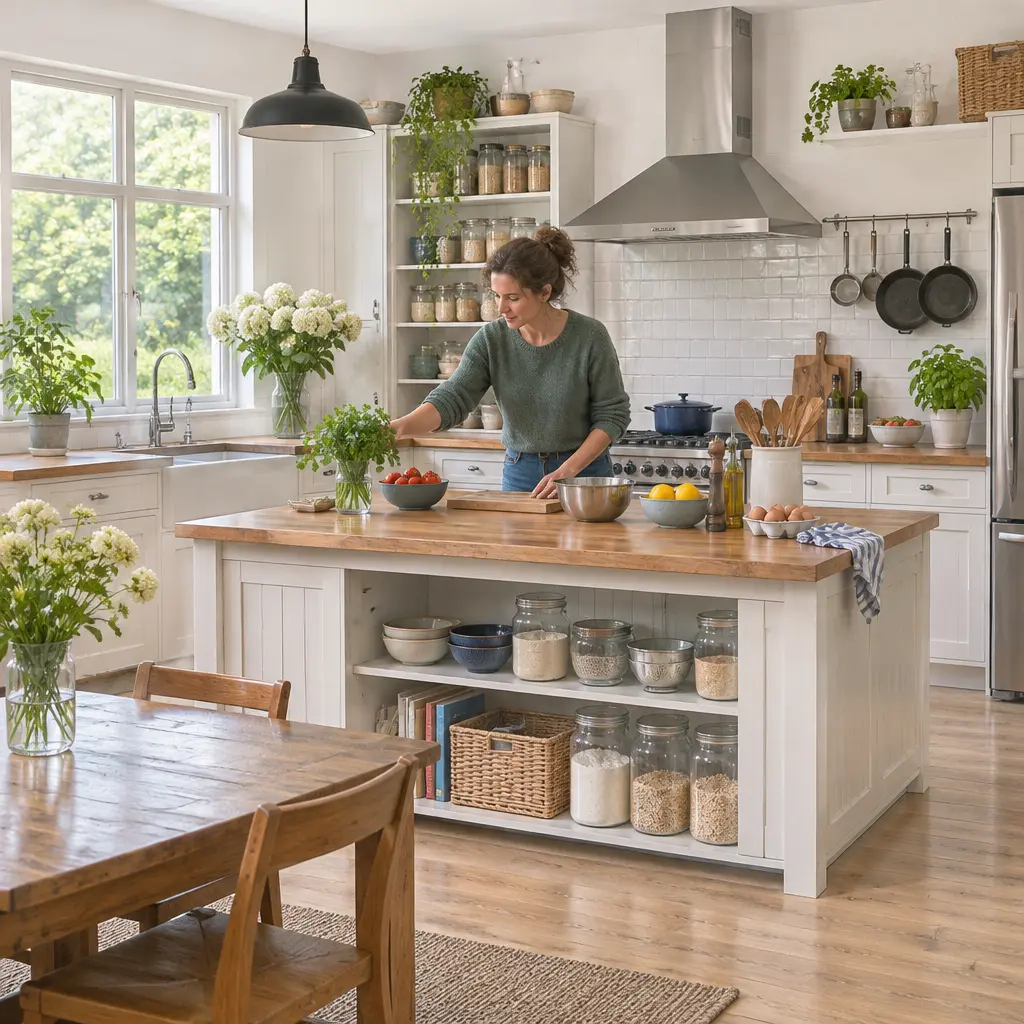
Kitchen workflow efficiency is the reduction of unnecessary movement, searching, and repeated handling while preparing, cooking, and cleaning. Organizing kitchen zones according to how often tasks and tools are used can make daily cooking more direct: keep frequently used items close to their point of use, reserve secondary zones for occasional tasks, and store rarely used equipment farther away. This approach builds on established kitchen-planning principles, including the work triangle, while adapting storage to real household habits. The U.S. Environmental Protection Agency estimates that food waste accounts for about 24% of municipal solid waste sent to landfills and combustion facilities, a reminder that practical storage and visible ingredients matter as well as speed. The sections below define frequency-based zoning, explain how to map and arrange zones, and offer a measured way to test the results.
Frequency-Based Kitchen Zoning: Definition and Principles
Frequency-based kitchen zoning is a method of arranging tools, ingredients, and work surfaces around the tasks performed most often. It is a practical application of activity-centered design: place items near the location where they are used, and give high-frequency tasks the most accessible space. The National Kitchen & Bath Association’s kitchen-planning guidance similarly emphasizes functional work areas and convenient relationships among preparation, cooking, and cleanup. There is no universal formula that assigns a fixed number of inches or seconds saved; the right arrangement depends on the household’s menu, space, mobility needs, and equipment.
The main hyponyms—more specific forms—of kitchen zoning include preparation, cooking, cleaning, storage, and serving zones. A compact kitchen may combine several of these on the same counter, while a larger kitchen may give each a distinct area. Frequency helps determine priority within each zone: daily-use knives and a cutting board belong within easy reach of the main preparation surface, whereas a specialty appliance used a few times a year can be stored higher, lower, or farther away.
Task Zones and Point-of-Use Storage
A task zone is a small area organized around a repeated activity. For example, a preparation zone may include a clear counter, cutting board, knife, mixing bowl, and commonly used seasonings. Point-of-use storage means keeping an item near the activity that requires it rather than grouping every item of the same type in one distant cabinet. This reduces avoidable trips and makes it easier to return tools to a consistent home.
The work triangle—connecting the sink, cooktop, and refrigerator—is a familiar planning concept, but it does not capture every modern kitchen task. A useful frequency-based layout considers the actual route from refrigerator to preparation surface to cooking area, as well as where dishes are unloaded and where waste is sorted. In a small kitchen, even a drawer divider or a counter caddy can make a zone more legible without remodeling.
Frequency Tiers
Frequency tiers classify items by how often they are used. A simple household system is daily, weekly, monthly or occasional, and seasonal or rarely used. These are practical categories rather than a published universal standard. The goal is to reserve the easiest-to-reach shelves and drawers for daily essentials, while avoiding valuable prime space being occupied by equipment used only on special occasions.
- Daily: plates, mugs, cooking oil, a chef’s knife, and the pan used most often.
- Weekly: baking tools, a blender, or ingredients used for regular meal preparation.
- Occasional: a roasting pan, specialty serving pieces, or a seldom-used appliance.
- Seasonal or rarely used: holiday molds or equipment that can be stored in less accessible locations.
Frequency is only one consideration. Weight, safety, accessibility, and food-storage conditions also matter. Heavy cookware should not be placed where retrieving it creates a lifting hazard, and perishable foods should remain in suitable storage regardless of how often they are used.
Map Cooking Frequency to Kitchen Zones
Once the principle is defined, the next step is to observe how the kitchen is actually used. A short task audit helps distinguish an imagined ideal workflow from the household’s real routines. Over several typical cooking days, note repeated trips, items that are frequently searched for, counters that become crowded, and tools that are used together. This informal record can reveal, for instance, that breakfast equipment needs a dedicated cluster even if dinner preparation receives most of the attention.
Preparation and Cooking Zones
The preparation zone is where ingredients are washed, cut, measured, and combined. Place a clear work surface near the refrigerator and sink when the layout permits, and keep daily-use cutting tools, boards, bowls, and measuring equipment close by. A small container for frequently used seasonings can help, but avoid crowding the work surface with items that are not part of the routine.
The cooking zone centers on the cooktop, oven, or other primary heat source. Store the most-used pans, cooking utensils, oven mitts, and everyday oils nearby, while keeping flammable materials away from heat. The U.S. Fire Administration advises keeping cooking areas clear and staying attentive while cooking; organizing tools within reach can support a safer routine, but it does not replace supervision or safe handling.
Cleaning, Storage, and Serving Zones
A cleaning zone usually centers on the sink and dishwasher, with dish soap, brushes, towels, and waste or recycling containers positioned for convenient use. Keep clean dishes close to the dishwasher if that is where they are unloaded, then place frequently used plates and glasses in nearby cabinets. This creates a simple return path instead of requiring clean items to cross the kitchen.
A food-storage zone includes the refrigerator, pantry, and any dry-goods cabinets. Arrange ingredients so routine meal components are easy to find and older products are not hidden behind newer purchases. The U.S. Department of Agriculture’s Food Safety and Inspection Service recommends keeping refrigerators at 40°F (4°C) or below; convenience should never undermine safe temperature control. A serving zone can be as simple as a drawer for utensils and a shelf for everyday dishes near the table or pass-through point.
A Simple Frequency Map
The following text-based map illustrates how frequency can guide placement. It is a starting point, not a rule: adapt it to the room’s layout, household members, and safe reach.
- Closest reach: daily tools and ingredients at their point of use.
- Nearby shelves and drawers: weekly-use items and replenishment supplies.
- Higher, lower, or less central storage: occasional and seasonal equipment, provided it can be retrieved safely.
A chart could show each item against two measures—use frequency and retrieval difficulty—to identify candidates for relocation. Items used daily but stored far from their task zone are the clearest opportunities for improvement.
Evaluate and Refine Kitchen Workflow Efficiency
A zone arrangement is a working system, not a one-time organizing project. After moving items, test the layout during normal meals and adjust it based on evidence. Useful measures include how often someone leaves the preparation area to retrieve a tool, how long common items take to locate, whether counters remain usable, and whether cleanup follows a direct route. These are household-level measures; there is no need to claim a universal percentage improvement when the result can be checked in the kitchen itself.
A Practical Before-and-After Test
Choose one repeated routine, such as making breakfast or preparing a weekday dinner. Before reorganizing, record the number of retrieval trips or interruptions and note any bottlenecks. Move only the relevant tools and ingredients, then repeat the routine under similar conditions. Compare the observations after several uses, not just one trial, because menu differences and interruptions can affect the result.
For example, a household that regularly makes coffee and toast might group mugs, coffee supplies, and bread-related tools near the breakfast counter. If the coffee maker’s position would block a primary preparation surface, the household can instead create a compact cabinet or tray-based breakfast station. The best arrangement is the one that improves the routine without interfering with other frequent tasks.
Accessibility, Safety, and Waste Prevention
Efficient zones should work for everyone who uses the kitchen. Frequently handled items should be reachable without climbing or awkward twisting, and sharp tools should be stored securely. Keep hot cookware and cutting tools arranged to reduce accidental contact, and preserve clear counter space for safe preparation. For households with children, older adults, or people with limited mobility, prioritize stable access and clear paths over maximizing cabinet capacity.
Organization can also support food visibility. The U.S. Environmental Protection Agency reports that food was approximately 24% of municipal solid waste sent to landfills and combustion facilities in 2018. That figure describes the U.S. waste stream, not waste caused solely by household storage practices. Still, placing soon-to-be-used ingredients where they are visible, labeling leftovers, and rotating pantry goods can help households notice food before it is forgotten.
Conclusion: Put the Most-Used Tasks First
Frequency-based kitchen zoning organizes preparation, cooking, cleaning, storage, and serving around real household routines. Its central principle is straightforward: keep daily-use items near the tasks they support, place occasional equipment in secondary storage, and account for safety, accessibility, food safety, and visibility. A task audit, a simple frequency map, and a repeated before-and-after test can turn that principle into a practical layout.
Start by tracking one routine this week, then move only the items that create repeated searching or unnecessary trips. Reassess after several uses, and keep the arrangement flexible as menus and household needs change. For further guidance, consult kitchen-planning recommendations from the National Kitchen & Bath Association and food-safety advice from the U.S. Department of Agriculture.
Sources: U.S. Environmental Protection Agency, Advancing Sustainable Materials Management: 2018 Fact Sheet, https://www.epa.gov/facts-and-figures-about-materials-waste-and-recycling/advancing-sustainable-materials-management; National Kitchen & Bath Association, Kitchen Planning Guidelines, https://nkba.org/info/kitchen-planning-guidelines/; U.S. Fire Administration, Cooking Safety, https://www.usfa.fema.gov/prevention/home-fires/prevent-fires/cooking/; U.S. Department of Agriculture, Food Safety and Inspection Service, Refrigeration and Food Safety, https://www.fsis.usda.gov/food-safety/safe-food-handling-and-preparation/food-safety-basics/refrigeration