
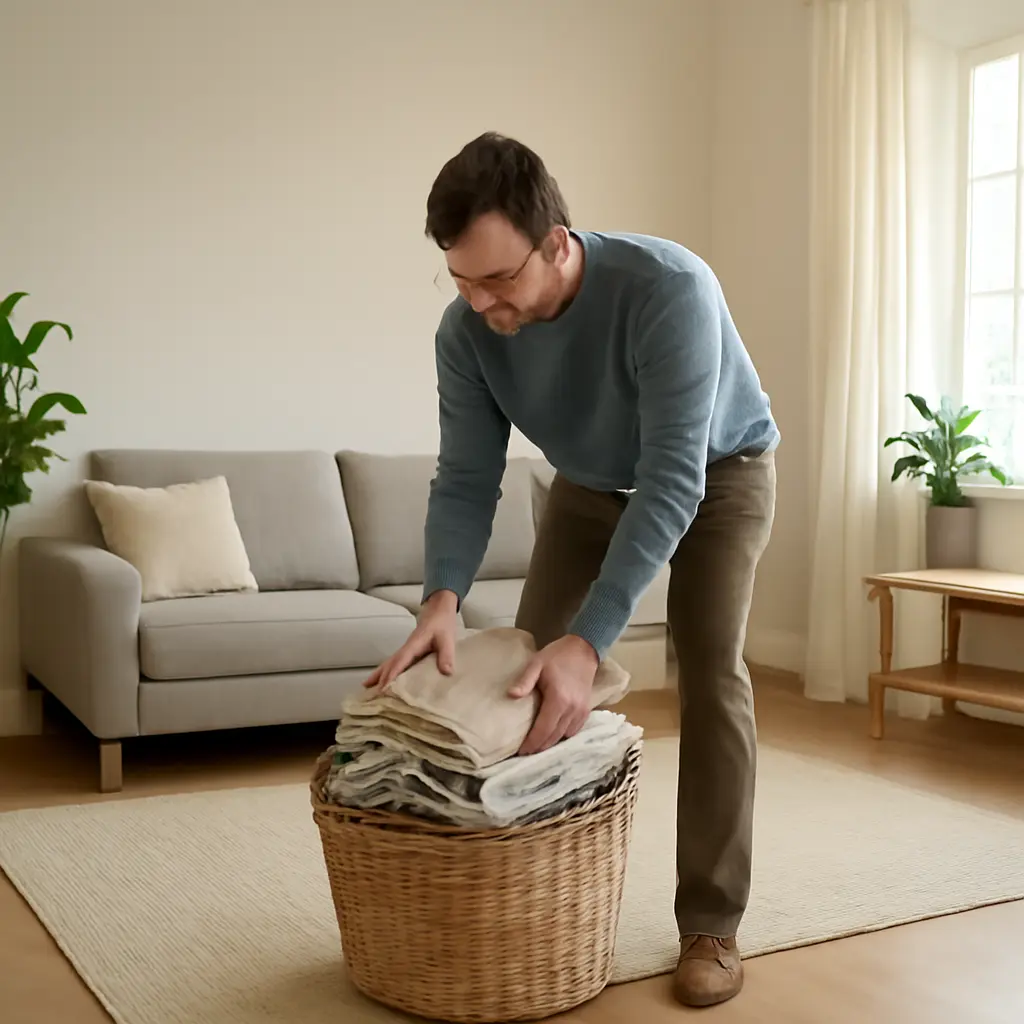
A woven basket is an open or lidded container made by interlacing flexible materials such as willow, grass, cane, or seagrass. It can replace some of the small, visible piles that make a home feel cluttered—provided it is sized for a specific task and used as a container, not as a catch-all for things that still need sorting. Its usefulness is less about hiding everything than about giving frequently used items a consistent place. That distinction matters: the U.S. Environmental Protection Agency estimates that Americans generated 292.4 million tons of municipal solid waste in 2018, but a basket organizes belongings rather than reducing waste by itself. The sections below explain how baskets work as storage, which styles suit which jobs, and how to choose and maintain one realistically.
Woven basket storage and household clutter
A woven basket is a storage container formed by crossing or interlacing strands around a base or frame. The Smithsonian’s National Museum of African Art describes basketry as a diverse craft tradition whose materials and techniques vary across cultures; in practical home use, those variations affect a basket’s strength, flexibility, appearance, and care requirements. A basket can make a room look tidier by grouping loose objects, but it does not increase the room’s storage capacity or make unwanted items disappear.
The most reliable approach is to match each basket to a defined category—such as throws, toys, or mail—and to the place where that category is used. This makes the basket a visible boundary for belongings. If the contents exceed its capacity, or if unrelated items accumulate inside, the basket can become clutter in a more attractive form.
Open baskets for everyday items
An open basket is a container without a lid, designed for quick access. It works well for items that are used and put away often, such as blankets beside a sofa, children’s toys in a play area, or shoes near an entry. The open top makes it easy to see what is inside, although it also leaves the contents visible and exposed to dust.
Choose a stable base and an opening wide enough for the objects being stored. For heavy loads, inspect the weave, handles, and bottom rather than assuming that a basket’s appearance indicates its carrying capacity. A low basket can be easier for children to use than a tall one, while a narrow basket may fit beside furniture without blocking a walkway.
Lidded baskets for visual calm
A lidded basket is a container with a cover that conceals its contents. It can reduce visual busyness in a living room or bedroom, especially for spare accessories and items that do not need constant access. But a closed lid also makes forgotten objects easier to overlook. Labeling the basket or assigning it a single category can help prevent that problem.
Do not use a lidded basket as a substitute for safe storage. Medicines, cleaning products, sharp tools, batteries, and other hazardous items should be kept according to their safety instructions and out of children’s reach. A decorative container is not necessarily child-resistant, moisture-proof, or secure.
Basket materials, construction, and placement
Basket performance depends on the material, weave, shape, and environment. Natural fibers such as willow, seagrass, and rattan have different textures and tolerances; paper cord and synthetic fibers offer other trade-offs. As a general rule, follow the maker’s care guidance and keep natural-fiber baskets dry unless the product is specifically designed for damp conditions.
Natural and synthetic fibers
Natural-fiber baskets are made from plant-based materials, while synthetic baskets use manufactured materials such as plastic or resin. Natural fibers can bring variation in color and texture, but moisture and prolonged dampness may encourage damage or mildew. Synthetic options may be easier to wipe clean, yet their durability and environmental effects depend on the material and how the product is made.
For bathrooms, laundry areas, or kitchens, check product instructions before buying. A basket used for damp towels needs airflow and regular emptying; a tight, lined container can hold moisture against fabric. For food, use only baskets intended for food contact, or place food in a suitable inner container.
Shape and location determine usefulness
A basket’s shape should reflect both its contents and its location. Low, wide baskets suit blankets or toys; tall baskets can hold rolled textiles; small trays can corral keys and mail on a console. Measure the intended space, including clearance for doors, drawers, and walking paths, before choosing a size.
Think of placement as part of the storage system: put a laundry basket where clothes are removed, a toy basket near the play area, and an entry basket near the items it will collect. This reduces the effort required to put things away. The basket is most effective when returning an item to it is easier than leaving that item on a nearby surface.
Can a basket replace household clutter?
A basket can replace scattered piles with one contained, purposeful group. It cannot replace decluttering, a filing system, or storage suited to fragile, valuable, or hazardous possessions. The distinction is important: organization changes where things are kept; decluttering reduces the number of things that need a place.
Use a one-basket test
Try one basket in the room that feels most disorganized. Give it a single job, choose a practical size, and check after a week whether its contents are being used and returned. If unrelated items keep appearing, the category may be too broad, or the basket may be in the wrong location.
A simple reset can keep the system working:
- Empty the basket and remove items that do not belong in its assigned category.
- Discard, donate, recycle, or relocate items according to their condition and local rules.
- Return the remaining items to the basket without overfilling it.
- Repeat on a schedule that suits the household, rather than waiting for the basket to overflow.
The U.S. EPA’s waste figures provide useful context for the broader challenge of consumption and disposal, but they do not show that baskets reduce household waste. A basket may support better habits by making possessions visible and easier to manage; any reduction in purchases or discarded goods depends on the choices people make.
A practical example: the entryway
In a small entryway, a shallow basket can gather reusable shopping bags, while a separate, clearly assigned container can hold hats or gloves. Keys and mail may be better kept in a small tray or wall-mounted organizer, where they remain easy to find. This example shows why one large catch-all basket is often less effective than a few appropriately sized storage points.
Keep the route through the doorway clear, and do not place a basket where it could create a trip hazard. If papers need action, sort them rather than storing them indefinitely; a basket can contain a temporary “to review” pile, but it should not become a permanent substitute for handling it.
Conclusion: a woven basket is a tool, not a cure
A simple woven basket can replace scattered household items with a more orderly, accessible collection when it has a clear purpose, suitable material, and sensible location. Open baskets favor everyday access; lidded ones conceal contents but can hide forgotten clutter. Neither type reduces the amount of stuff on its own.
Start with one recurring pile, decide what genuinely belongs there, and choose a basket that fits the objects and available space. Then review its contents regularly. For further guidance, consult the EPA’s waste-prevention resources and the maker’s care instructions for the basket you choose.
Sources: U.S. Environmental Protection Agency, National Overview: Facts and Figures on Materials, Wastes and Recycling, https://www.epa.gov/facts-and-figures-about-materials-waste-and-recycling/national-overview-facts-and-figures-materials; Smithsonian National Museum of African Art, Art and Life in Africa: Basketry, https://africa.si.edu/exhibits/africa/basketry.html