
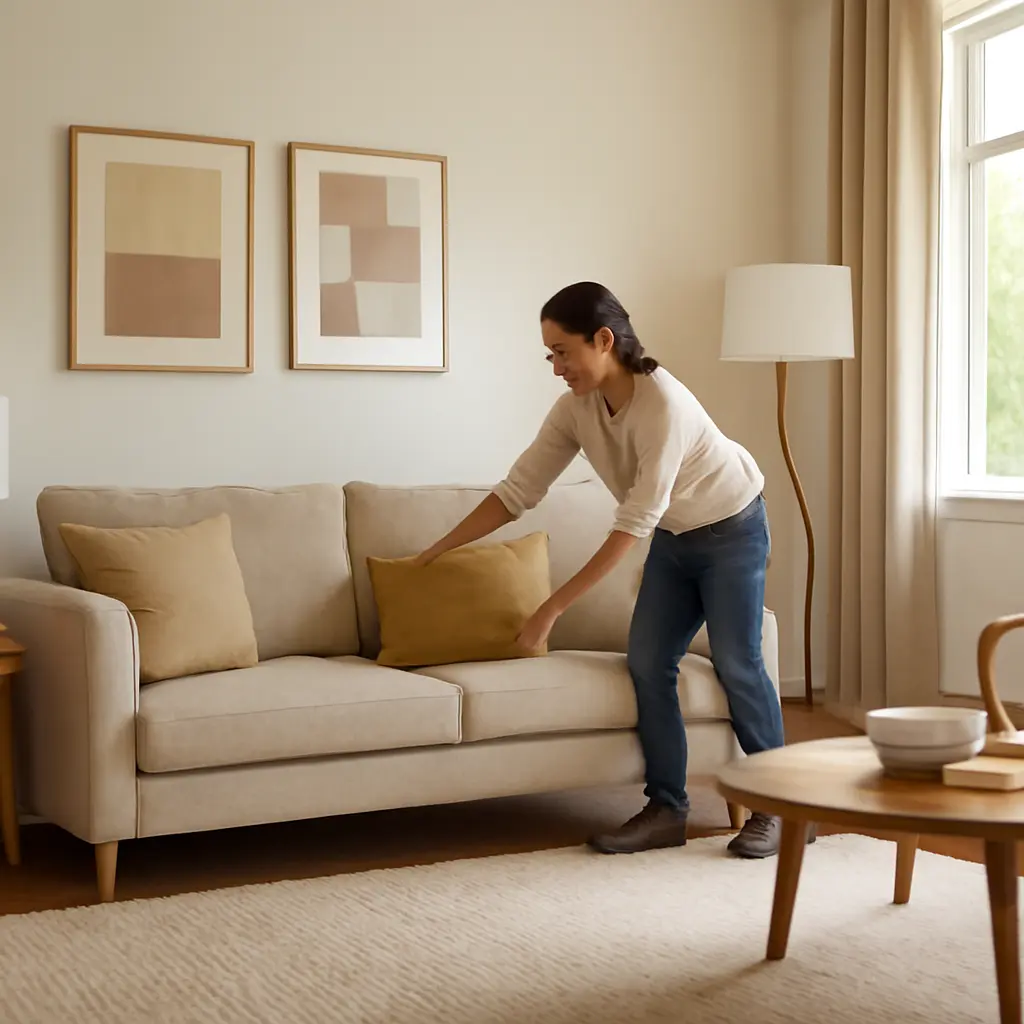
A living room feels expensive when its proportions, materials, lighting, and finishes work together—not simply when every object carries a luxury price tag. Interior designers often build that impression through a clear focal point, layered light, tactile natural materials, balanced scale, and carefully edited styling. Those choices matter beyond appearances: the U.S. Environmental Protection Agency estimates that people spend about 90% of their time indoors, making comfort and everyday usability part of good design. This playbook explains how to establish a polished layout, choose convincing materials, layer lighting, coordinate color and texture, and finish with restraint—while adapting each principle to a real household budget.
Design principles that make a living room feel expensive
“Expensive-looking” is a visual effect, not a formal design classification. In practice, it describes a room that appears intentional: furniture is scaled to the space, materials feel coherent, lighting is considered, and clutter does not compete with the architecture. The American Society of Interior Designers (ASID) describes interior design as a process that considers people’s needs, health, safety, and well-being alongside aesthetics. That broader view helps explain why a convincing room must function as well as photograph well.
The main design principles have close relatives, or hyponyms: layout includes circulation and furniture grouping; material strategy includes upholstery, wood, stone, and metal; lighting includes ambient, task, and accent layers; and styling includes art, textiles, and object placement. Treating these as connected decisions is more effective than shopping for a single “statement” item.
Begin with proportion, layout, and a focal point
A focal point is the feature that first attracts attention, such as a fireplace, a large window, an architectural detail, or a substantial piece of art. Arrange seating to acknowledge that feature while preserving comfortable routes through the room. A layout that is easy to navigate feels composed; furniture pushed against every wall or crowded around a tiny rug can make even quality pieces seem misplaced.
Measure the room, furniture, and doorways before buying. Use painter’s tape to outline a proposed sofa and rug, then check whether doors open and people can move naturally between seating and other areas. There is no universal spacing formula that suits every room, so test the actual plan rather than relying on a rigid rule. In open-plan spaces, a rug and a deliberate seating group can mark the living zone without blocking sightlines.
Choose materials for texture and durability
Material quality is communicated by both appearance and touch. A mix of matte and reflective finishes, smooth and nubby textiles, and warm and cool surfaces creates depth. Consider wool, linen, leather, wood, stone, ceramic, and metal as options, but judge each by its intended use and care needs. Natural materials are not automatically more durable or sustainable; performance depends on construction, finish, maintenance, and sourcing.
A practical designer’s approach is to invest in the pieces that receive the most use, then use smaller accents to introduce variety. Check upholstery construction, removable-cover instructions, fabric cleaning codes, wood joinery, and finish consistency. The U.S. Federal Trade Commission’s textile-labeling rules require disclosures such as fiber content and country of origin for many textile products, giving shoppers useful information to compare materials rather than relying on vague marketing terms.
Layer lighting instead of relying on one ceiling fixture
Layered lighting combines ambient light for general visibility, task light for activities such as reading, and accent light to draw attention to art or architectural features. A ceiling fixture can provide a base, while floor lamps, table lamps, and directional fixtures add useful pools of light at different heights. Dimmers make it easier to shift from daytime activity to a softer evening atmosphere.
The U.S. Department of Energy notes that light-emitting diode (LED) bulbs use at least 75% less energy and last up to 25 times longer than incandescent lighting. When selecting bulbs, compare brightness in lumens, color appearance in kelvins, and compatibility with dimmers. Consistency matters: bulbs with noticeably different color temperatures in the same room can make finishes look mismatched.
Color, textiles, and styling that create a polished living room
Once layout and lighting are settled, color and styling give the room its character. A restrained palette does not have to mean an all-neutral interior. It means that colors, patterns, and finishes have a deliberate relationship, with enough contrast to keep the space from feeling flat. Repeating a small number of tones across upholstery, art, cushions, and accessories helps separate a coherent scheme from a collection of unrelated purchases.
Build a palette with controlled contrast
A color palette is a planned set of hues and neutrals used across a space. Start with a fixed feature that will remain—such as flooring, a fireplace surround, or a large existing sofa—and select supporting colors around it. Vary the lightness and texture of related tones so that the room has dimension. A single accent color can appear in several small places, while a contrasting material or darker element supplies visual weight.
Test paint and fabric samples in the actual room at different times of day. Daylight direction and artificial bulbs change how colors appear, and a shade that looks balanced in a store may read much warmer or cooler at home. This simple test can prevent costly repainting and reduce the temptation to compensate for a poor color match with additional decor.
Use rugs, curtains, and cushions to add softness
Soft furnishings add texture, improve comfort, and help define a seating area. A rug should relate to the furniture group rather than appear as a small island beneath a coffee table. Curtains can make a window feel more substantial when their width and length suit the opening, while cushions and throws introduce pattern without requiring a large commitment.
The U.S. Environmental Protection Agency’s indoor-air guidance recommends controlling sources of indoor pollution and improving ventilation where appropriate. For a living room, that is a reminder to consider cleaning and maintenance as part of material selection: washable covers, low-emission products, and regular dust removal can support a more comfortable space. Follow product labels and manufacturer instructions, particularly for delicate textiles and finishes.
Edit accessories and hang art with intention
Styling is the act of selecting and arranging objects so that they support the room rather than compete for attention. Group a few pieces with varied heights or shapes, leave visible space around them, and use trays or shelves to give small objects a clear home. A thoughtfully chosen book, vessel, or lamp can be more effective than many inexpensive decorations spread across every surface.
Art should relate to the scale of the wall and nearby furniture. A small frame floating above a large sofa can look accidental; a larger work or a deliberately arranged group can provide a more balanced anchor. Before hanging, lay out the arrangement on the floor or make paper templates. Keep the composition aligned with the furniture or architectural feature it is meant to accompany.
A budget-conscious designer’s process
A polished room does not require replacing everything at once. The most reliable approach is to diagnose the space, prioritize improvements, and make purchases only after measuring and testing. The U.S. Bureau of Labor Statistics’ Consumer Expenditure Survey tracks household spending on furnishings and equipment, underscoring that home purchases compete with other household needs. A clear priority list helps direct limited funds toward changes with the greatest functional and visual impact.
- Remove items that are broken, unused, or visually distracting, and identify what the room must support.
- Measure the room and test a furniture plan before shopping.
- Address practical needs first, such as a comfortable seat, a correctly sized rug, or a useful reading light.
- Choose a limited palette and repeat its tones through existing and new pieces.
- Upgrade high-use items selectively; consider secondhand furniture, repair, or reupholstery where appropriate.
- Finish with art and accessories only after the larger elements are in place.
For example, a renter with a neutral sofa and a limited budget might keep the main furniture, reposition it around the window, add a larger rug that connects the seats, introduce two lamps with compatible bulbs, and repeat one accent color in cushions and art. The result can feel more unified without requiring a complete renovation. This is an illustrative design scenario, not a claim that one particular arrangement works for every room.
Conclusion: make the room feel considered, not merely costly
A living room feels expensive when its layout is purposeful, its materials are chosen with care, its lighting is layered, and its colors and accessories form a coherent whole. Proportion establishes order; texture and durable materials add depth; lighting supports comfort; and editing gives the finished room breathing space. These principles can be applied gradually, including in rented homes and on modest budgets. Start by measuring your room, identifying its focal point, and choosing one practical improvement to make next. For further guidance, consult ASID’s resources on interior design, the Department of Energy’s lighting advice, and the EPA’s indoor-air guidance.
Sources: American Society of Interior Designers, What Is Interior Design?, https://www.asid.org/about/what-is-interior-design; U.S. Environmental Protection Agency, Indoor Air Quality, https://www.epa.gov/report-environment/indoor-air-quality; U.S. Federal Trade Commission, Threading Your Way Through the Labeling Requirements Under the Textile and Wool Acts, https://www.ftc.gov/business-guidance/resources/threading-your-way-through-labeling-requirements-under-textile-wool-acts; U.S. Department of Energy, LED Lighting, https://www.energy.gov/energysaver/led-lighting; U.S. Bureau of Labor Statistics, Consumer Expenditures—2023, https://www.bls.gov/news.release/cesan.nr0.htm