
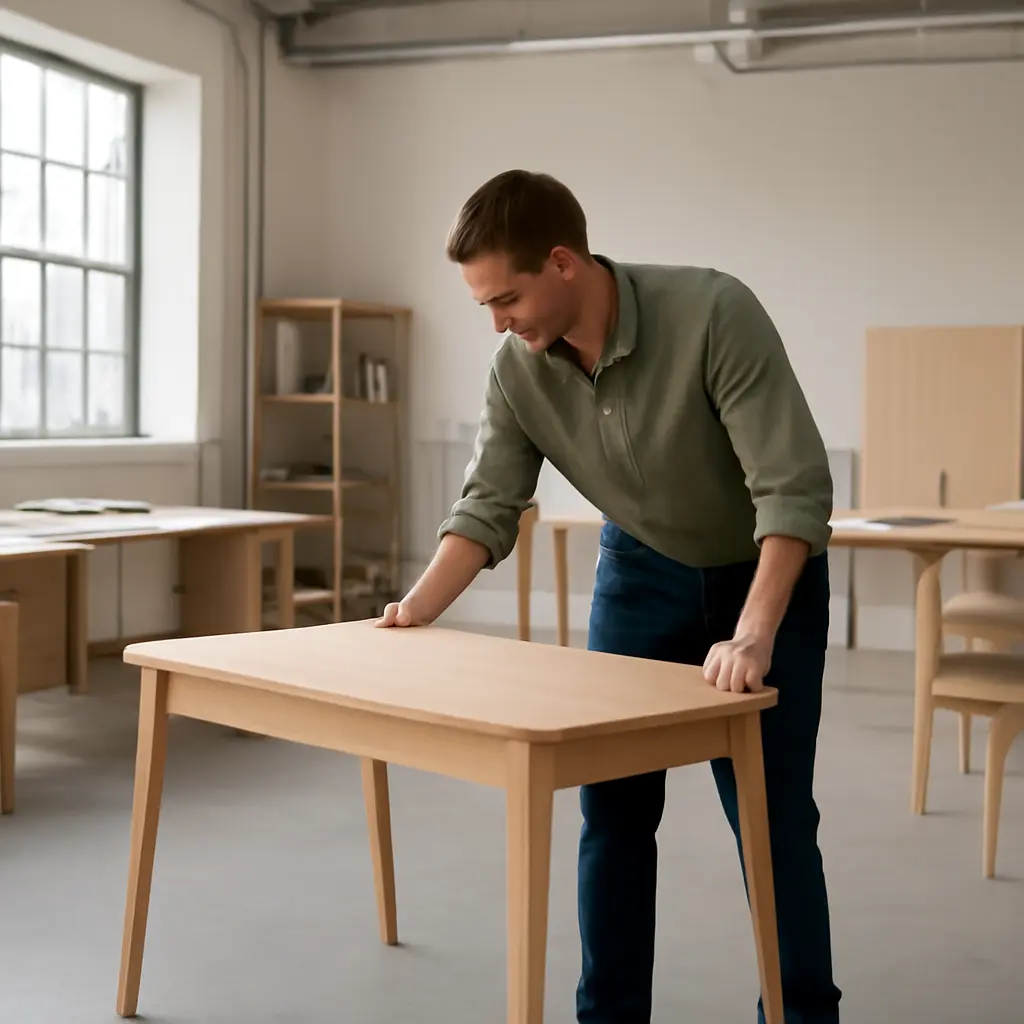
A smart-furniture design studio is a workspace where designers, engineers, and researchers combine furniture design with sensing, connectivity, software, and manufacturing expertise. Creating tomorrow’s smartest furniture solutions means more than adding screens or voice controls: it means developing useful, comfortable, repairable products that fit real environments. That goal matters as people work and learn across changing settings, while the U.S. Environmental Protection Agency estimates that furniture and furnishings made up 12.1 million tons of municipal solid waste in the United States in 2018. Inside the studio, human-centered research, connected technology, inclusive ergonomics, prototyping, and circular design provide a practical framework for responding to both user needs and resource impacts.
How a Smart-Furniture Design Studio Defines Tomorrow’s Solutions
A smart-furniture design studio is a cross-disciplinary product-development environment that integrates furniture, electronics, software, and user research into products designed for particular tasks and places. The International Organization for Standardization describes human-centred design in ISO 9241-210 as an approach that improves interactive systems by focusing on users, their needs, and the context of use. Applied to furniture, that principle means evaluating not only whether a connected feature works, but whether it improves comfort, access, safety, or a routine the user actually performs.
The studio’s work spans several related categories: connected desks and tables, adaptive seating, modular storage, workplace systems, and furniture that supports care or learning. These are hyponyms of the broader smart-furniture category because each applies sensing or digital capabilities to a specific furniture type and purpose. Their shared challenge is integration: hardware must fit the product, software must be maintainable, and the design must remain usable when the network or power is unavailable.
Human-centered research and user needs
Human-centered research is the process of observing users and testing assumptions before committing to a design. In a studio, interviews, contextual observation, task analysis, and accessibility reviews help reveal how people use a chair, desk, or shared table over time. The resulting requirements should be specific—for example, a desk should adjust quietly, remember a user’s preferred height, and still operate manually if its controls fail.
This discipline is especially relevant to work environments. The U.S. Bureau of Labor Statistics reported that 35% of employed people did some or all of their work at home on days they worked in 2023. That figure does not prove demand for any particular connected product, but it illustrates why studios must consider varied rooms, work patterns, and user preferences rather than designing only for a conventional office.
Ergonomics and inclusive interaction
Ergonomics is the application of knowledge about people to the design of tasks, equipment, and environments. For furniture, it covers posture, reach, adjustability, stability, and the effort required to operate controls. Inclusive interaction extends this work to people with different bodies, abilities, ages, and levels of technical confidence. A well-designed adjustable chair, for instance, should provide clear, reachable controls and understandable feedback rather than assuming every user can rely on an app.
The World Health Organization’s 2022 global report estimates that 1.3 billion people—about 16% of the world’s population—experience significant disability. This broad estimate is a reminder that accessibility cannot be treated as a small-market feature. Studios can validate inclusive designs through a combination of recognized accessibility standards, user testing, and direct evaluation of reach, force, legibility, and alternative control methods.
How Connected Furniture Combines Sensors, Software, and Privacy
Connected furniture uses electronics and software to collect or exchange information, automate an action, or give users feedback. Its capabilities can include occupancy sensing, posture or movement feedback, adjustable controls, charging, environmental monitoring, and integration with workplace systems. The most successful designs begin with a defined benefit; connectivity by itself is not evidence of value.
As studios move from physical ergonomics to connected features, they must also address the invisible parts of the product: data flows, security updates, account requirements, and long-term support. A chair that records usage or a desk that reports occupancy can affect privacy even if its primary purpose is comfort or space planning.
Sensors and useful feedback
Sensors convert physical conditions—such as position, pressure, movement, or proximity—into signals that a product can interpret. A sit-stand desk might use position sensors to control height, while an occupancy sensor could help a facilities team understand how shared spaces are used. Designers should test accuracy, latency, failure states, and whether a user can understand or override the system.
The National Institute of Standards and Technology’s Internet of Things work emphasizes that connected devices create security considerations across device capabilities, communications, and their operating environment. For furniture teams, this means choosing components and data practices early—not treating security as a software task added after the prototype is finished.
Privacy, cybersecurity, and user control
Privacy-by-design is the practice of considering personal information and user control throughout product development. A studio should map what data the furniture collects, why it is necessary, where it is stored, who can access it, and how long it is retained. Data minimization, local processing where practical, clear consent, and a non-connected mode can reduce unnecessary exposure and preserve basic functionality.
The Federal Trade Commission’s guidance for businesses stresses reasonable security, data minimization, and clear representations about consumer information. In practical design reviews, teams can use a data-flow diagram and threat assessment alongside the usual wiring and usability checks. These methods help distinguish genuinely useful functions from features that collect data without a clear user benefit.
How Prototyping and Testing Validate Smart Furniture
Prototyping is the creation of progressively more complete models to test form, function, usability, and manufacturability. In a smart-furniture studio, prototypes range from foam mock-ups and adjustable rigs to working electronics and production-intent samples. Each stage answers different questions: does the furniture fit the body, do the controls make sense, and can the product be assembled and serviced reliably?
This process links the design concept to evidence. Rather than relying on a polished demonstration, teams should test products in realistic settings and document performance across repeated use, different users, and predictable failure conditions.
Rapid prototypes and iterative design
Rapid prototyping uses inexpensive, quickly produced models to expose problems while changes are still manageable. Physical mock-ups help assess dimensions and reach; electronics benches test sensors and actuators; software simulations reveal how settings and feedback behave. Iteration means revising the design in response to test results and repeating the evaluation rather than treating the first working model as finished.
The National Institute of Standards and Technology’s research on smart manufacturing highlights the importance of connecting design and production information across a product’s lifecycle. For studios, digital models and clear test records can help engineers, manufacturers, and service teams work from consistent specifications and identify changes before full-scale production.
Validation, durability, and safety
Validation confirms that a product meets defined user and performance requirements; verification checks that it was built according to its specifications. Furniture testing can cover load capacity, stability, cycles of adjustment, material wear, electrical safety, and software behavior. Applicable standards depend on the product and market, so studios should identify relevant requirements early and use qualified testing laboratories where necessary.
A useful test plan includes normal operation and foreseeable misuse: a cable pulled during adjustment, a desk repeatedly raised under load, or a control used by someone unfamiliar with the interface. Recording failures and corrective actions creates traceability and reduces the risk of relying on anecdotal demonstrations.
How Circular Design Shapes Smart-Furniture Materials and Repair
Circular design aims to keep products and materials in use through durability, maintenance, repair, reuse, and recycling. For smart furniture, this is especially important because a long-lived frame can be undermined by a short-lived battery, controller, or unsupported application. Designing electronics as replaceable modules can help preserve the furniture’s useful life and reduce the need to discard an entire product when one component fails.
The environmental stakes are substantial. The U.S. Environmental Protection Agency estimated that furniture and furnishings accounted for 12.1 million tons of municipal solid waste in 2018, with about 0.3 million tons recycled. Those figures cover the broad furniture category, not smart furniture alone, but they show why design studios should consider end-of-life pathways alongside appearance and performance.
Materials, modularity, and repairability
Repairable and modular furniture separates components so that damaged or outdated parts can be replaced without discarding the whole product. Studios can support this through accessible fasteners, standardized electrical connections, spare-part availability, repair documentation, and materials that can be separated at end of life. Material choices should also account for durability, emissions, responsible sourcing, and compatibility with local recovery systems.
The Ellen MacArthur Foundation’s circular-design framework encourages designers to consider products as part of systems that maintain value and reduce waste. A practical studio review can therefore ask whether a battery is replaceable, whether software support has a defined lifetime, and whether upholstery or control modules can be serviced independently of the frame.
Lifecycle thinking and product support
Lifecycle thinking evaluates impacts from raw-material extraction through manufacturing, transport, use, repair, and disposal. It can help teams compare design options that appear similar at purchase but differ in energy use, component replacement, or useful life. For connected products, lifecycle planning should include firmware updates, battery replacement, data deletion, and what happens when a companion app or cloud service is discontinued.
An example is a connected sit-stand desk designed with a standard mechanical lifting structure, replaceable control box, and manual adjustment option. If its app becomes obsolete, the core furniture can remain functional; if a controller fails, service staff can replace that module rather than the entire desk. This kind of design connects digital convenience with long-term product resilience.
Conclusion: Building Smarter Furniture Responsibly
Tomorrow’s smart-furniture solutions emerge from the combined work of human-centered research, inclusive ergonomics, carefully chosen connected features, iterative testing, and circular design. A design studio should treat sensors and software as components of a physical product—not as substitutes for comfort, reliability, repairability, or user choice. With 35% of employed people working at home on some or all of their workdays in 2023 and furniture waste remaining a substantial U.S. environmental concern, adaptable and durable furniture is increasingly relevant.
For designers, manufacturers, and buyers, the next step is to ask measurable questions: What user need does each connected feature address? Can the product work without an account or network? Can it be repaired, updated, and safely retired? Further reading from ISO, NIST, the World Health Organization, and the EPA can help teams turn those questions into design requirements and test plans.
Sources: International Organization for Standardization, ISO 9241-210:2019 Ergonomics of human-system interaction—Part 210: Human-centred design for interactive systems, https://www.iso.org/standard/77520.html; U.S. Bureau of Labor Statistics, American Time Use Survey—2023 Results, https://www.bls.gov/news.release/atus.nr0.htm; World Health Organization, Global report on health equity for persons with disabilities, 2022, https://www.who.int/publications/i/item/9789240063600; National Institute of Standards and Technology, IoT Device Cybersecurity Capability Core Baseline, https://csrc.nist.gov/pubs/ir/8259/a/final; Federal Trade Commission, Protecting Personal Information: A Guide for Business, https://www.ftc.gov/business-guidance/resources/protecting-personal-information-guide-business; National Institute of Standards and Technology, Smart Manufacturing Systems Design and Analysis Program, https://www.nist.gov/programs-projects/smart-manufacturing-systems-design-and-analysis; U.S. Environmental Protection Agency, Facts and Figures about Materials, Waste and Recycling: Furniture and Furnishings, https://www.epa.gov/facts-and-figures-about-materials-waste-and-recycling/furniture-and-furnishings; Ellen MacArthur Foundation, Circular Design Guide, https://www.circulardesignguide.com/.